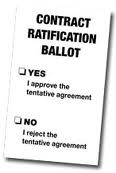
In a recent decision, PERC Hearing Examiner Page A. Garcia held that the International Organization of Masters, Mates and Pilots union provided employees with adequate notice and opportunity to vote on the ratification of tentative agreements the union had negotiated with the Washington State Ferries. Washington State Ferries, Decision 11899 (MRNE, 2013).
Pending in the Court of Appeals, the August ruling by Pierce County Judge James Orlando, holding that an interest arbitration order by Arbitrator Howell Lankford that Kitsap County Deputies incur a retroactive increase in their insurance premiums, was unconstitutional and unlawful. Earlier this month, we discussed the detailed legal theories involved in Orlando's ruling. But, a new question concerning the scope of bargaining under PERC law is raised by Orlando's ruling: if a retroactive change in health insurance premiums or benefits is unconstitutional or unlawful, does that remove it from the scope of bargaining?
In Washington State University, the Public Employment Relations Commission upheld an appeal by a union that WSU committed an unfair labor practice, reversing the Hearing Examiner. The union alleged that WSU unlawfully contracted out a roof repair project and breached its good faith bargaining obligation in the manner in which the employer invoked a contractual time limit for bargaining. With one Commissioner absent, the divided remaining two commissioners were split on the “skimming” charge, so the Examiner decision that no skimming occurred stands. But, the Commission determined that 13 other pending bargaining demands were improperly ignored by WSU.
The Public Employment Relations Commission recently affirmed Examiner Romeo’s ruling that Washington State University (WSU) refused to bargain with the Public School Employees of Washington union when it failed to bargain an increase in employees’ workloads caused by a layoff. Washington State University, Decision 11704-A (PSRA 2013).
In Port of Seattle, Hearing Examiner Emily Martin found that the Port did not discriminate against Officer Brian Torre, the Shop Steward for the Teamsters Local 117 Commissioned Officers Bargaining Unit. Although Officer Torre was engaged in protected activity by serving as a shop steward, the union member could not show that he was “deprived of an ascertainable right or benefit” when the Port’s sole adverse action was to “coach” him on “providing better customer service.” Examiner Martin also found criticism of Officer Torre by Commander Jon Hornbuckle, who was also a Teamster shop steward for the supervisor’s unit, did not constitute unlawful interference.
Both unions and employers have the right to designate who represents them in the collective bargaining process. In Kiona Benton School District, PERC Hearing Examiner Guy Coss ruled, without a hearing, after a motion for “summary judgment”, that the Kiona Benton Education Association breached its duty to bargain in good faith by refusing to bargain with the School District’s designated collective bargaining representatives.
A union representative is generally permitted to assist a fellow union member who is facing a discipline investigation. But, does that assistance include speaking with potential witnesses? And if so, when can a union representative speak with those potential witnesses?
Regressive bargaining occurs when one party at the bargaining table in some manner attempts to make a proposal that is less attractive than the proposals it had previous advanced. In City of Tacoma, PERC Hearing Examiner Claire Nickleberry found that the City breached its good faith bargaining obligation by making a regressive wage proposal.
In Washington State Ferries, Examiner Whitney concluded that the Washington State Ferries committed an unfair labor practice (ULP) when it unilaterally eliminated a Kingston Ferry shed that ferry workers used as a break room, without providing the Inland Boatman’s Union an opportunity to bargain. The employer was ordered to reinstate the shed break room. Washington State Ferries, Decision 11825 (MRNE, 2013).
In Pierce County, PERC Examiner Emily Whitney concluded that Pierce County did not commit an unfair labor practice (ULP) regarding deputy sheriff’s leave use during the snow closures in 2012. The County had determined that deputy sheriff’s would be deemed essential and would have to submit paid leave in the event they were absent. The Deputy Sheriff’s Guild filed a ULP asserting that the distinction between “essential” and “nonessential” employees had not been negotiated and that no leave should be required if the deputies were unable to report to work. But Whitney concluded that there was no change to the status quo regarding deputies during the snow closures, and that the County did not unilaterally change the deputies leave utilization. Pierce County, Decision 11818.