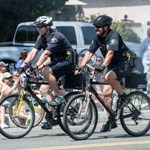
In City of Renton, PERC Examiner Coss dismissed the Renton Police Officers’ Guild’s Unfair Labor Practice complaint, which challenged the pay scheme for bicycle officers. The Examiner held that, contrary to the Guild’s allegations: (1) the City did not engage in direct dealing with Officers when it created a new payment method; (2) the Guild had actually agreed to end the alternate payment method and so the City did not unilaterally change the bike pay; and (3) the Guild’s complaint was barred by the statute of limitations.
In a precedent setting case, in Kitsap County v. Kitsap Cty. Corr. Officers’ Guild Inc., the Court of Appeals held that the County committed an unfair labor practice when it laid off two corrections officers without negotiations with the Kitsap County Corrections Guild. Facing the Guild’s demand to bargain, the County refused to bargain over the decision, asserting that the layoffs were not a mandatory subject of bargaining The Court held that negotiations must precede the lay off decision.
In King County (Amalgamated Transit Union, Local 587), PERC held that ATU Local 587 committed a ULP when it submitted a permissive subject of bargaining to interest arbitration. Examiner De La Rosa found that King County’s decision to move the Millwrights from the Vehicle Maintenance Section to the Power & Facilities Section was a managerial prerogative and therefore a permissive subject of bargaining.
In Central Washington University, the Commission concluded that the existing standard for determining whether an employer had a duty to bargain a decision to contract out bargaining unit work was confusing and adopted a new standard. The Commission also affirmed the Examiner’s decision that (1) the employer contracted out bargaining unit work and (2) that the employer failed to provide requested information. The Commission reversed the Examiner’s decision and found that the employer circumvented the union and modified the remedy to include a monetary remedy for the employer’s failure to bargain the decision to contract out bargaining unit work.
In State – Washington State Patrol, Examiner Page A. Garcia held that the State failed to provide relevant information regarding documents and communication between the State and a consultant concerning a compensation survey, which was requested by the Union for contract negotiations. PERC further held that by the State’s refusal to make individuals from the consultant’s firm available to the Union or, in the alternative, provide the Union the information it was seeking from the consultant regarding the compensation survey, the employer breached its good faith bargaining obligations.
In Mason General Hospital (Mason Public Hospital District 1), Examiner Irvin held that the employer did not refuse to bargain by unilaterally installing a new security camera in the Diagnostic Imaging Department. Examiner Irvin found that the hospital’s decision to install the new security camera was not a mandatory subject of bargaining.
In Washington State Ferries, the Commission affirmed Examiner Slone-Gomez’s decision that the Inland Boatmen’s Union of the Pacific did not refuse to bargain in violation of RCW 47.64.130(2)(c). The Commission stated that the Washington State Ferries was unable to prove that the Union negotiated to impasse on a non-mandatory subject of bargaining.
In Washington State University, Examiner Whitney held that the University did not refuse to bargain when it reduced the wages of its employees in the Facilities Operations, Custodial Services unit. Examiner Whitney stated that the University’s changes to the bargaining unit’s wages were made in conformance with their current 2013-2015 CBA.
In Community Transit, PERC Examiner Ramerman held that installation of video cameras on buses is not a mandatory subject of bargaining. Examiner Ramerman reasoned that: (1) video cameras had already been used in the buses, albeit in a more limited capacity; (2) bus drivers have no reasonable expectation of privacy while driving the buses; and (3) the cameras could further the employer’s significant interest in passenger and driver safety. Based on these three determinations, Examiner Ramerman concluded that the employer is not required to bargain with the bus drivers’ union over the camera installation.